
If you’re thinking about extending or altering your home, permitted development rights (PDR) can be an excellent way to progress a project without the time and cost of a householder or full planning application. But while PDR can speed up the process, the rules aren’t as relaxed as many people expect and getting them wrong can quickly turn a simple idea into a stressful situation.
This guide explains what permitted developments rights are, what they cover, and when you may still need planning permission. It’s designed to help you make informed decisions before starting any work on your home.
What Are Permitted Development Rights?
Permitted development rights allow certain building works and changes of use to go ahead without requiring householder planning permission. The aim is to streamline straightforward projects and reduce unnecessary applications for developments considered to have minimal impact.
However, “permitted” doesn’t mean “anything goes”. Each project type comes with a strict set of conditions and limits, and you must meet every one of them for your project to qualify.
Common Projects Covered by Permitted Development Rights:
Typical homeowner improvements fall within PDR, including:
- Single-storey rear extensions (within specified depth and height limits).
- Two-storey extensions (subject to particularly strict criteria).
- Loft conversions, including dormers and hip-to-gable alterations.
- Outbuildings, such as garden offices, studios or workshops.
- Porches.
- Some changes of use, depending on the building type and location.
It’s worth noting that flats and maisonettes do not benefit from PDR, and any extension or alteration to them requires planning permission.
Understanding Limits and Conditions:
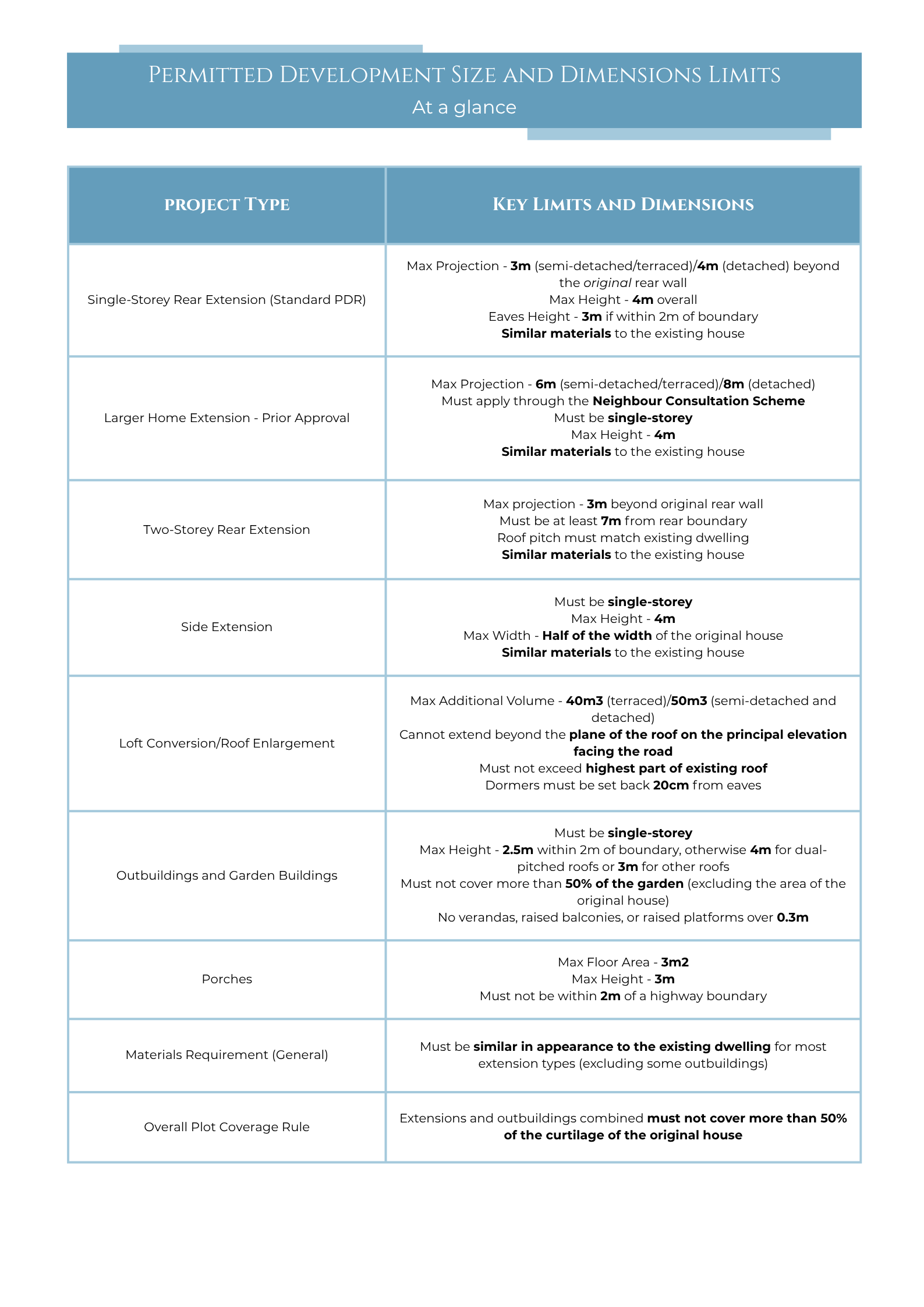
To qualify under PDR, your project must comply with detailed rules. These typically relate to:
- Maximum extension depth, width or volume.
- Height restrictions for extensions and roof alterations.
- The overall size of your plot.
- Distances from boundaries.
- Restrictions on placing extensions forward of the principal elevation.
- The requirement to use materials that are similar in appearance to the existing house.
If even one of these criteria is not met, the project no longer falls under permitted development, and either householder or full planning permission will be required.
When Permitted Development Rights Do Not Apply:
There are several situations where Permitted Development Rights are restricted or removed entirely:
- Conservation areas
- National Parks, Areas of Outstanding Natural Beauty and the Broads
- Sites of Special Scientific Interest
- World Heritage Sites
- Listed buildings (permitted development rights do not apply at all)
- Properties subject to an Article 4 direction, where the local authority has removed certain rights to protect the character of the area
- Homes created through certain change-of-use permitted development, for example a barn conversion, which may have reduced or removed rights afterwards
- Homes that have already been extended under permitted development rights in the past
Even in these areas, development is still possible, it simply requires a different planning application.
Other Consents You May Still Need:
Permitted development rights only relate to planning permission. You may still require:
- Building Regulations approval
- Structural calculations
- Party Wall Act notices
- Highways or drainage consents
- Freeholder or covenant approval, depending on your property
Permitted development rights can offer a way to skip the planning queue in certain scenarios, but this is not done by bypassing every other requirement.
Why Professional Advice Makes a Difference:
While PDR can offer a faster route to building, it’s easy to misinterpret the rules or overlook a detail that pushes a project out of compliance. Working with an architectural designer ensures:
- Accurate assessment of whether your project qualifies under permitted development.
- Designs that achieve your goals while staying within the permitted limits.
- Early identification of risks or alternative approaches.
- Proper coordination of Building Regulations and other required consents.
- Smoother communication with neighbours and your contractor.
At Austin John Architectural, we help clients make confident, informed decisions, whether a project proceeds under permitted development or requires a householder planning application.
Examples of Typical Scenarios:
Permitted Development Rights:
A single-storey rear extension on a standard house, within the depth and height limits, using materials in keeping with the existing building.
Not Permitted Development Rights:
The same extension but located within a conservation area where rights are restricted.
Permitted Development Rights:
A loft conversion that stays within the 40m³ or 50m³ volume limit (depending on house type).
Not Permitted Development Rights:
A loft conversion that raises the ridge height or extends beyond the existing roof slope.
Real-world examples like these highlights how two seemingly similar projects can fall under completely different planning requirements.
Pre-Project Checklist for Homeowners:
Before progressing your design, consider:
- Does your property benefit from permitted development rights?
- Is your home in a protected area or subject to an Article 4 direction?
- Does your proposal meet the size, height and appearance rules?
- Do you need building regulations, structural engineering or party wall consent?
- Would a householder planning application offer more design flexibility?
If you’re unsure at any stage, it’s always worth seeking professional guidance.
Example of a Permitted Development Prior Approval Application:
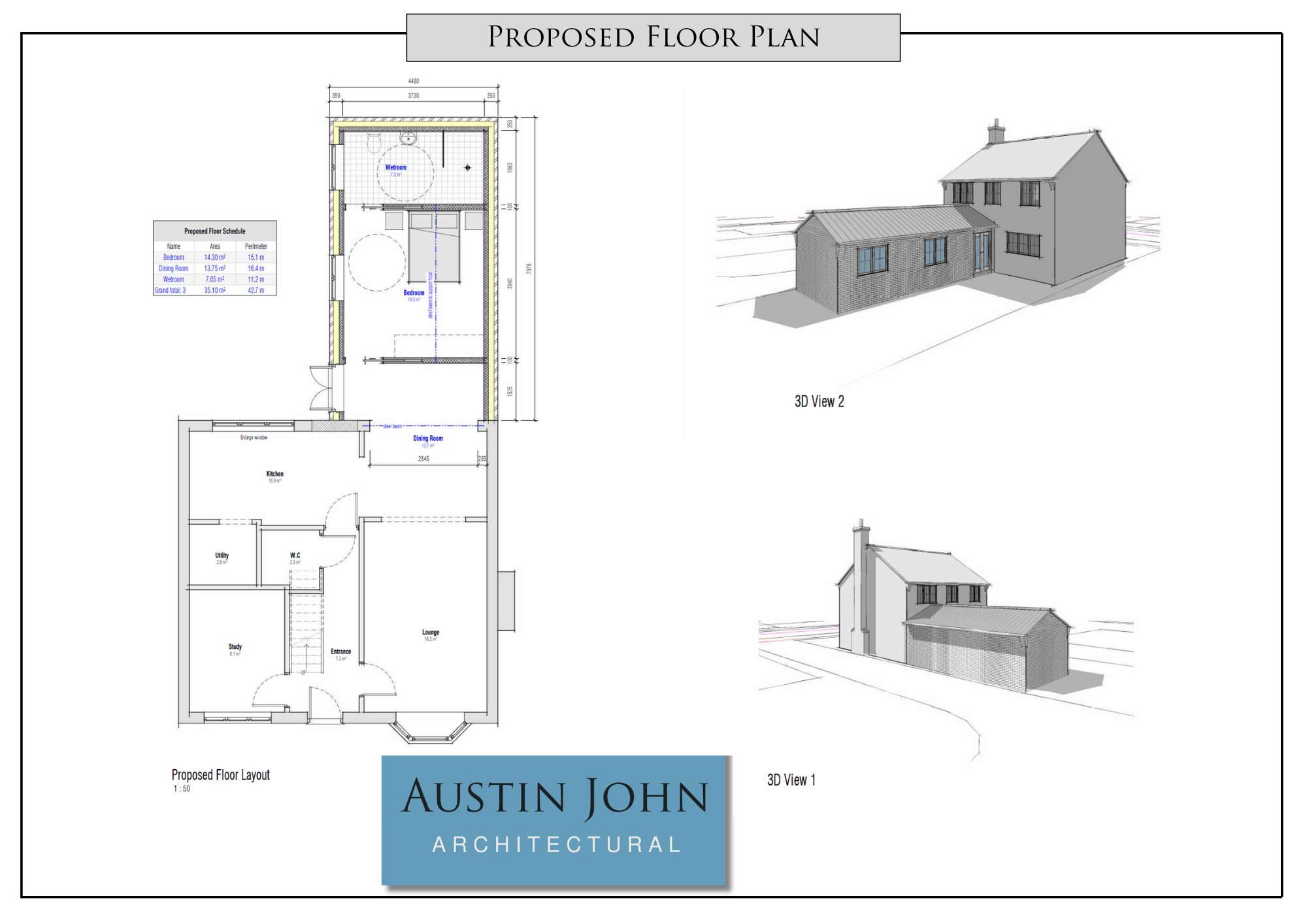
The designs for this proposed single storey rear extension fell under a prior approval ‘Larger Home Extension’ which applies to single-storey rear extensions on both detached and semi-detached or terraced houses. Our clients were happy to ensure that the materials would match that of the existing house, and as this design met all the other requirements, a prior approval application was submitted.
Need help confirming your permitted development rights? Get in touch today! We offer an in person initial consultation for a Permitted Development Check for homeowners and developers. Share your address and a brief description of your ideas, and we’ll confirm whether your project is likely to fall under permitted development rights or whether a householder planning application would be required.
If you’re planning changes to your home and want the process to be smooth, compliant and beautifully designed, feel free to get in touch. We’re always happy to help.
Keep up to date with our live projects and office adventures on our Facebook page.